Most home embroidery machines can’t stitch structured caps. See which Brother machines list cap frame capability, and how to do hats on a flatbed PE900 instead.
If you want to embroider structured baseball caps, you need a machine that takes a cap frame. Of the Brother machines we checked, only the PRS100 Persona, PR680W and the new PR1X list cap frame capability. A flatbed home machine like the PE900 can still do hat patches and soft, unstructured caps floated on adhesive stabilizer, but it is not a cap machine.
Brother lists cap frame capability only on the PRS100, PR680W and PR1X among the models we checked.
Brother’s PE, SE, NQ and PP1 pages don’t mention cap frames, so don’t plan structured caps on them.
The PRS100 is single needle with a free arm; the PR680W is a 6-needle machine for volume.
Jump to a section
Our shortlist
Picks are based on published manufacturer specifications checked October 7, 2026. Confirm current price, warranty and included accessories with the seller.
Hats are one of the most requested embroidery projects and one of the most oversold. Many listings imply any embroidery machine can do caps. The honest answer is that a typical flatbed home machine can’t hoop a structured baseball cap properly, because the front panel is curved, stiff and attached to a brim.
This guide sorts out which machines are actually built for caps, according to the makers, and what you can realistically do on a home machine instead. EmbroideryWise is research-based; every machine claim below comes from the maker’s product page.
Can a home embroidery machine embroider hats?
It depends on the hat.
Hat type
Flatbed home machine (PE900, SE2000, NQ1700E)
Cap-frame machine (PRS100, PR1X, PR680W)
Structured baseball cap
Not a realistic option
Yes, with a cap frame
Soft, unstructured cap (dad hat)
Possible by floating on adhesive stabilizer, small area
Yes
Beanie or knit hat
Possible on a small area; floating needed
Easier with a free arm or tubular access
Hat patch to attach later
Yes, stitched flat in a normal hoop
Yes
A cap frame (sometimes sold with a cap driver) holds the curved front of a cap so the machine can stitch across it. Of the Brother machines we checked, only the PRS100 Persona, PR680W and PR1X list cap frame capability. Brother’s pages for the PE, SE, NQ and PP1 machines don’t mention cap frames, so don’t buy one of those expecting to stitch structured caps.
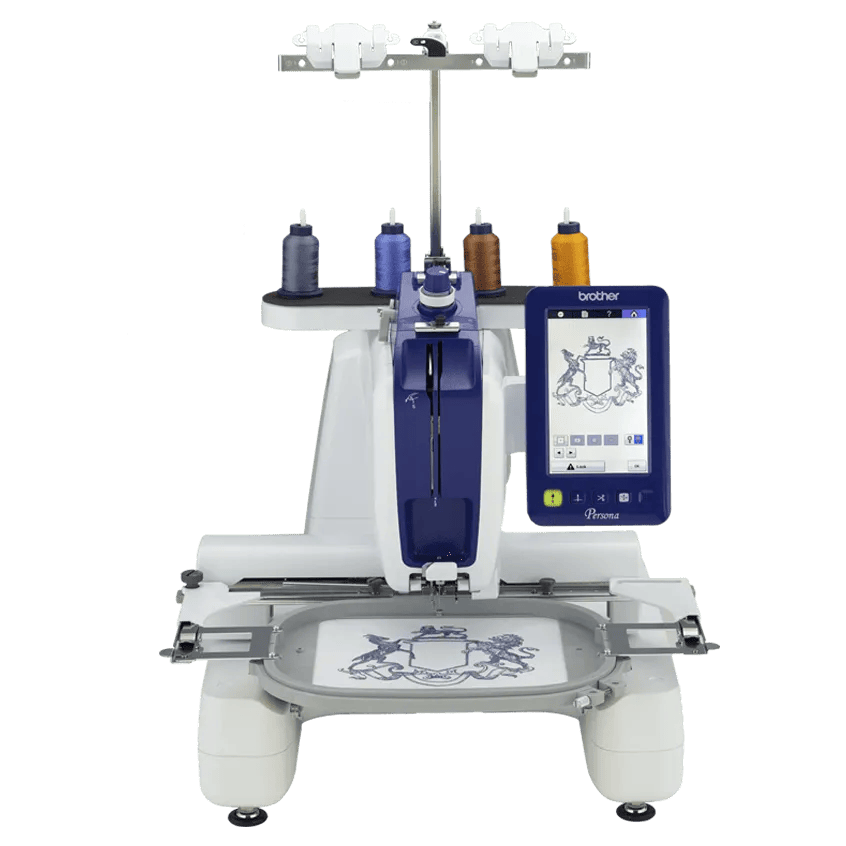
Brother PRS100 Persona: the cap-capable single-needle machine
Brother lists the PRS100 with an 8 × 8 inch field, speeds up to 1,000 stitches per minute, a 7 inch LCD, USB transfer and cap frame capability, with a speed range of 400 to 600 spm on cap frames. Brother describes free arm embroidery “to reach areas like caps, sleeves and bags.”
It is still a single-needle machine, despite the commercial styling. You change thread for every color, as on a PE900.
Who it’s for: hobbyists and small sellers who want structured caps, sleeves and bags without moving to a multi-needle machine.
Skip it if: you mostly do flat items, or you want automatic color changes for multi-color logos in volume.
What to check: Brother’s page lists cap frame capability; confirm whether the cap frame is included in the specific bundle or listing you are buying. Brother’s page also gives two design counts (445 and “over 405”).
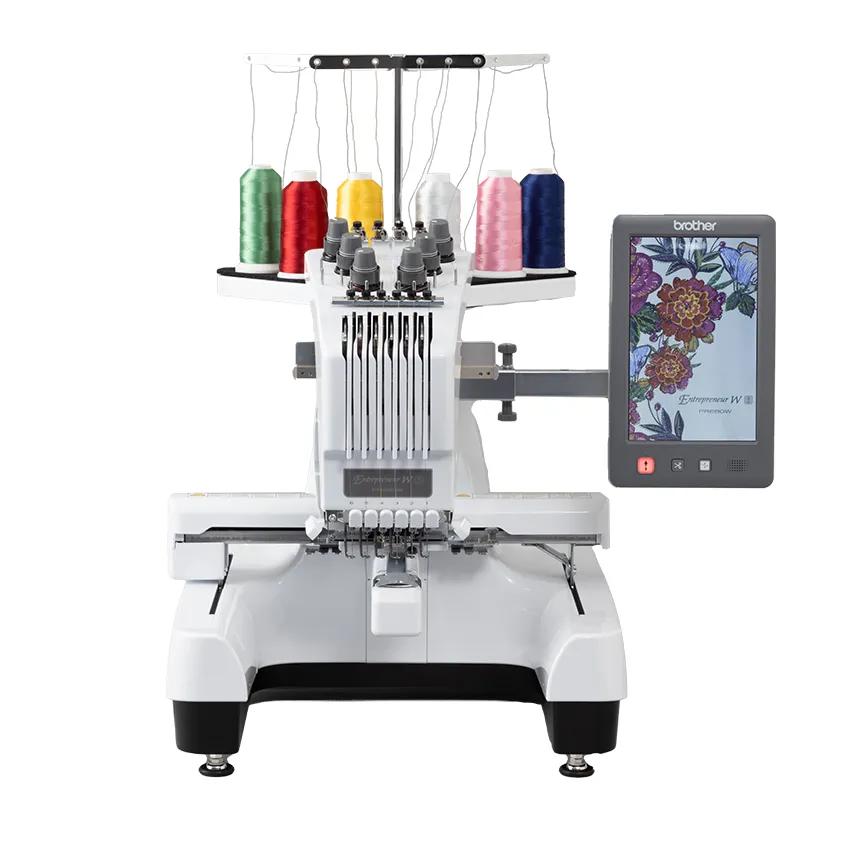
Brother PR680W: hats as a business
Brother lists the PR680W as a 6-needle machine with an 8 × 12 inch field, up to 1,000 stitches per minute, a 10.1 inch touchscreen, Wi-Fi and cap frame capability. With six needles threaded, it changes colors on its own, which matters when you are stitching the same three-color logo on many caps.
Budget for the cap frame. Brother’s page lists 1.5 × 2, 8 × 12, 5 × 7 and 4 × 4 inch hoops as included, and the cap frame is not in that list.
Who it’s for: people taking hat orders regularly, where time per cap and less babysitting matter.
Skip it if: you are a hobbyist making a few hats a year. It is a different class of machine in cost and footprint.
What about the Brother PR1X?
Brother launched the PR1X “Entrepreneur One” in July 2026. Brother lists it as a single-needle machine with an 8 × 12 inch field, up to 1,000 spm (400 to 600 on cap frames), a 7 inch LCD, a free arm for “caps, sleeves, and bags,” cap frame capability and no Wi-Fi. Brother lists 4 × 4 and 8 × 12 inch frames as included.
It isn’t in our machine database yet, but it is worth comparing with the PRS100 if you want a larger field on a single-needle, cap-capable machine.
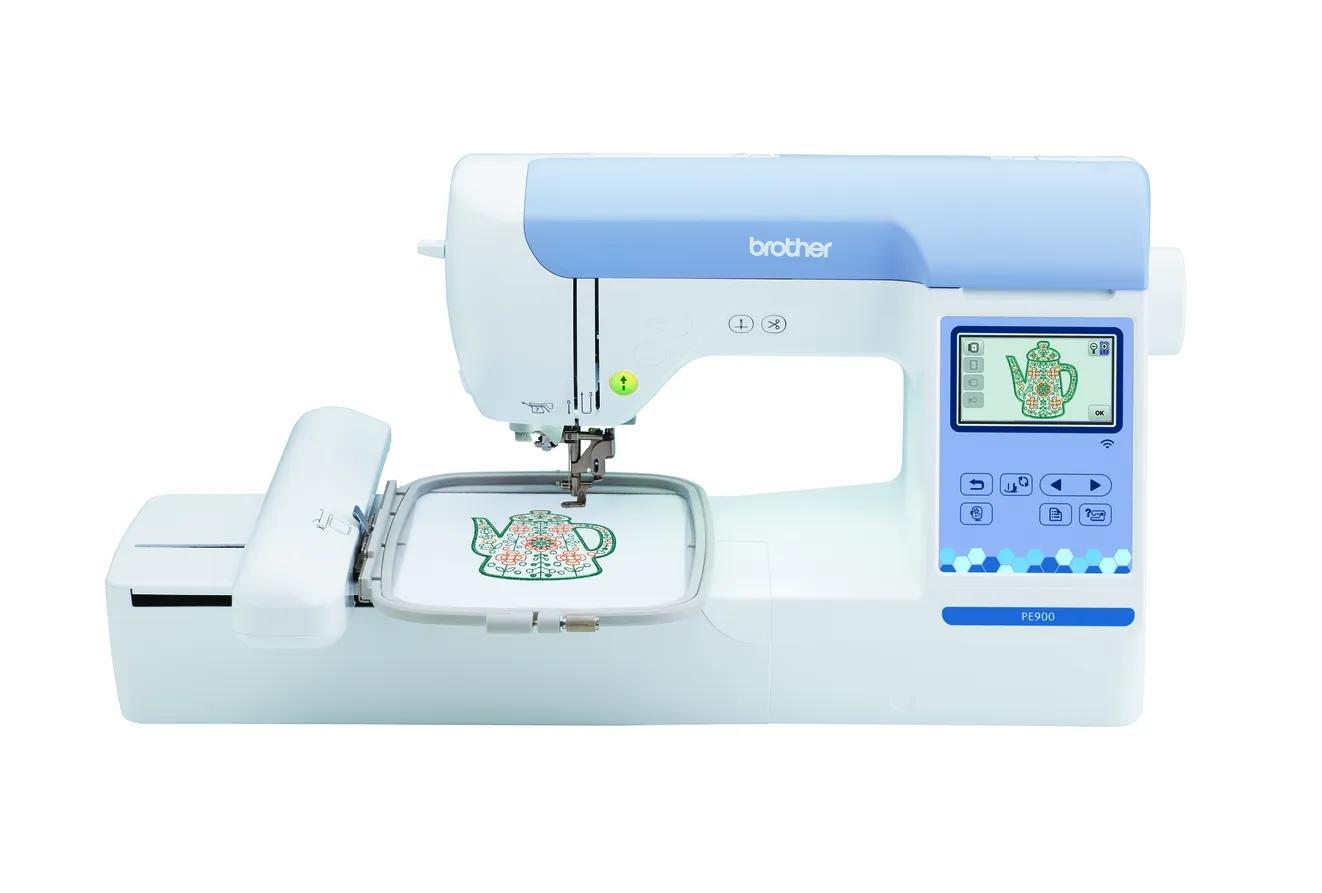
Brother PE900: the flatbed option for patches and unstructured caps
The PE900 is a 5 × 7 flatbed embroidery machine. Brother lists 193 designs, 13 fonts, 650 spm, Wi-Fi and jump stitch trimming, and no cap frame capability. That makes it a good machine for hat-adjacent work rather than caps themselves.
Who it’s for: beginners who want to make hat patches and occasional soft caps, alongside shirts, towels and bags.
Skip it if: structured caps are the main reason you are buying a machine. Look at the PRS100 or PR1X instead.
The same applies to the SE2000 and NQ1700E: a larger flat field doesn’t help you reach the curved front of a structured cap.
Stitch the design flat in a normal hoop, then attach the patch to the hat. This works on any embroidery machine and on any hat, including structured caps. Madeira lists patches and emblems among the uses for its washaway mesh, which dissolves completely. Patches also let you stitch several at once in a larger hoop.
Option 2: Float an unstructured cap on adhesive stabilizer
OESD’s home-machine method is to hoop a piece of its StabilStick peel-and-stick stabilizer, then press the flattened front of the cap onto the sticky surface. Hatch describes the same idea as floating: hoop only the stabilizer and attach the material on top without stretching it.
OESD’s tips for this method:
Choose soft, unstructured caps; OESD notes that “the more structured the hat is, the more difficult it will be to embroider.”
Expect a small stitchable area. OESD’s example cap had about 3½ inches wide by 2½ inches tall of usable space. Print a template and audition it on the cap first.
Use a 90/14 needle, which OESD calls “a good choice for most caps.”
Slow the machine down, watch that the cap stays flat, and don’t use the basting function.
Turn off all thread cutters while stitching the cap, so hoop movement doesn’t dislodge it.
Measure your cap’s flat area and check your design against it in the hoop fit checker using custom dimensions.
Option 3: Embroider the fabric before the hat is made
If you sew, you can embroider a cap panel or bucket-hat piece while it is still flat, then construct the hat. This sidesteps the curved-front problem entirely, and pairs well with a combo machine; see our combo machine guide.
What stabilizer and needle do caps need?
For structured caps hooped on round cap frames, Madeira makes a tear-away called E-Zee Cap and says two pieces can help with hard-to-hoop caps. For floating soft caps on a home machine, OESD’s guide describes its adhesive StabilStick as suited to hard-to-hoop items.
On needles, Madeira lists caps alongside twill, denim and canvas as tightly woven items that suit a sharp needle. OESD suggests a 90/14 for most caps. Our stabilizer types guide and needles guide cover the details.
Five questions to answer before you buy a machine for hats
Hat plans are an easy place to overspend or underspend. Answer these first:
Structured or unstructured? Look at the hats you actually want to decorate. If they have a stiff front panel that holds its shape, you are in cap-frame territory. If they are soft and fold flat, a flatbed machine can work.
How big is the design? Floated caps on a home machine leave a small flat area; OESD’s example was about 3½ × 2½ inches. Big logos that wrap around the front need a cap frame.
How many colors? On any single-needle machine, including the PRS100 and PR1X, every color means a stop and a re-thread. A three-color logo on 20 caps is 60 thread setups.
How many hats? A few gifts a year is a hobby; weekly orders are production. Brother lists cap-frame speeds of 400 to 600 spm on the PRS100 and PR1X, below their 1,000 spm flat-frame maximum, so cap work takes longer per stitch.
Would patches do? Patches let any machine decorate any hat, including structured caps, and you can stitch them in batches.
If your answers are “unstructured, small, few colors, a few hats,” a PE900 is enough. If they are “structured, many colors, many hats,” you are shopping for a PR680W-class machine.
Which machine should you buy for hats?
Choose the PE900 if hats are one project among many, and patches or soft caps are enough.
Choose the PRS100 if you want structured caps, sleeves and bags, and single-needle color changes are acceptable.
Look at the PR1X if you want the PRS100 approach with a larger 8 × 12 field and don’t need Wi-Fi.
Choose the PR680W if you are selling hats in quantity and multi-color logos need to run with fewer stops.
What do you give up at each level?
Machine
Hats you can do
What you give up
PE900
Patches, soft unstructured caps
Structured caps; small stitchable area on floated caps
PRS100
Structured caps with a cap frame, free-arm items
Automatic color changes; Wi-Fi (USB only)
PR680W
Structured caps with a cap frame, multi-color runs
Not structured caps on a cap frame: Brother’s PE900 page doesn’t list cap frame capability. You can embroider patches to attach to hats, and soft unstructured caps floated on adhesive stabilizer, within the small flat area you can reach.
Which Brother machines can use a cap frame?
Of the Brother machines we checked, the PRS100 Persona, PR680W and PR1X list cap frame capability. Check whether the cap frame is included in the bundle you buy, because Brother’s PR680W included-hoop list doesn’t show one.
Do I need a multi-needle machine for hats?
No. The PRS100 and PR1X are single-needle machines that list cap frame capability and a free arm. A multi-needle machine like the PR680W mainly saves time on multi-color designs and larger runs.
What needle should I use for caps?
OESD suggests a 90/14 needle for most caps on a home machine, and Madeira lists caps among the tightly woven items that suit a sharp needle.
Are hat patches a good workaround?
Yes. You stitch the patch flat in a normal hoop, then attach it to the hat. Madeira lists patches and emblems among the uses for its washaway mesh stabilizer.
✓
Sources & method
This guide is compiled from manufacturer documentation and specialist sources, not hands-on testing. We link every source so you can check it. Specifications change, so confirm details against your exact model manual. How we research.
 Best flatbed option for patches and unstructured capsCheck price